
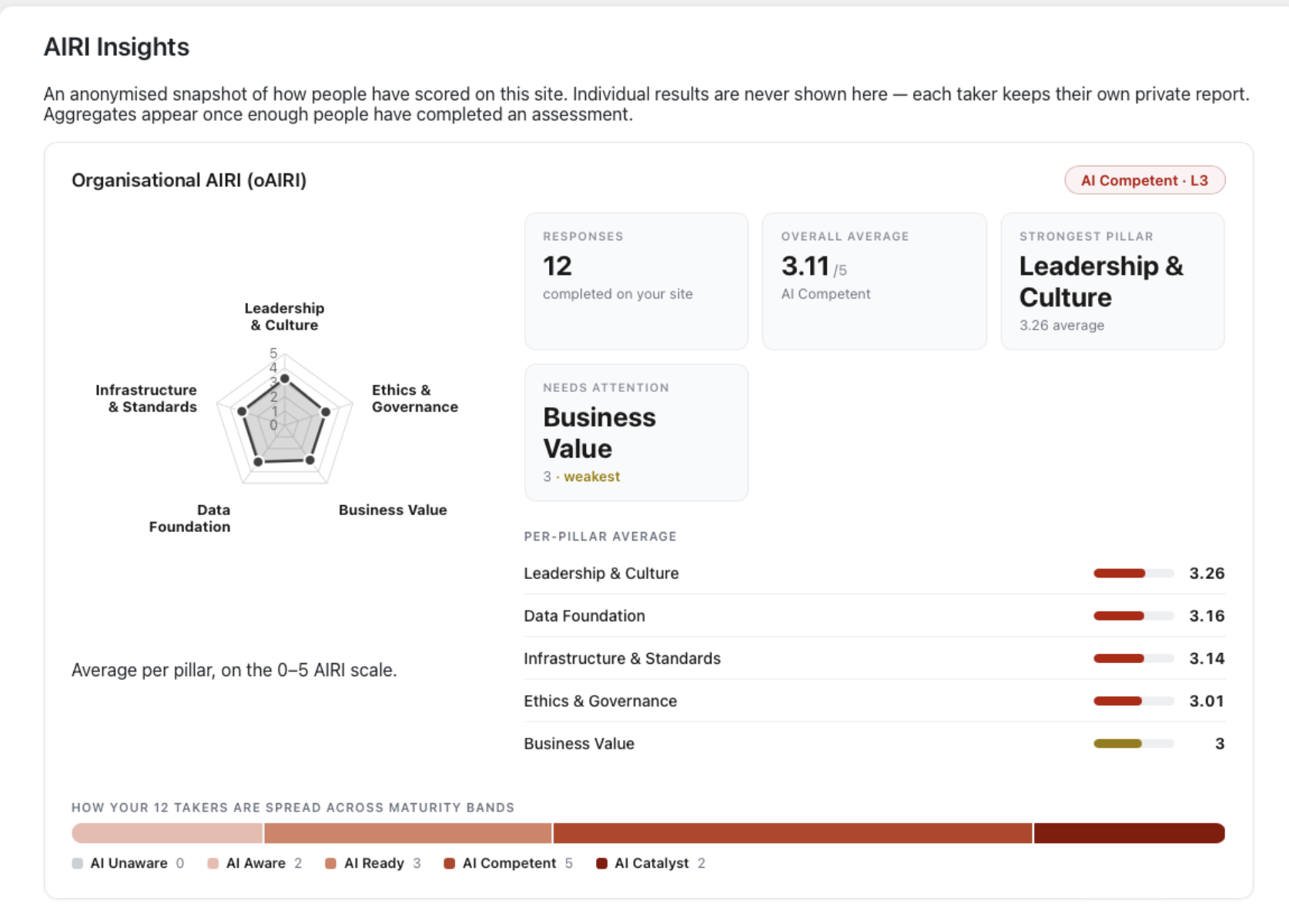
An open standard that nobody can run is not a standard. It is a document. I have spent a long time learning the difference, and airihub.io, which I am launching today, is what I have learned put into practice.
Start with the framework.

The AI Readiness Index (AIRI) began in 2019, out of a plain need: organisations had no structured way to see where they stood with AI, so we built one. It grew into two instruments today that share one architecture — Personal AIRI (pAIRI) for individuals and Organisational AIRI (oAIRI) for organisations — across five pillars, fifteen dimensions, and seventy-five behavioural anchors that measure what a person or an organisation actually does, not what it says it knows. The current version, v3.1, is released under Creative Commons CC BY 4.0. Anyone may use it, adapt it, and share it, with attribution. It is free by design.
That openness is not a marketing decision. It is a conviction I have held for more than twenty years. For most of my career I argued, inside government and out, that knowledge which can lift a whole industry should be open rather than locked behind a licence. Publicly funded research was paid for once; people should not have to pay again to use it. I lost that argument more often than I won it. I did not stop making it. Releasing AIRI under an open licence was the same argument, won on my own terms.
Open is necessary, but it is not sufficient
Here is what I underestimated. Publishing a framework openly removes the licence barrier. It does not remove the effort barrier. A specification document — even a good one, even a free one — still asks the reader to do a great deal of work before it produces a single answer. Read the pillars. Understand the scoring. Build the assessment. Stand up somewhere to run it. Collect the responses. Compute the results. Interpret them. Every one of those steps is a place where a busy association or a small agency quietly gives up.
I saw this directly as the framework travelled. Serbia was the first country outside Singapore to adopt the index, roughly three years ago, to help its small and medium enterprises see where they stood. Poland, France, Germany, and Malaysia followed. Through the Global Partnership on Artificial Intelligence, the plan is for more than thirty member countries to use the index as the maturity instrument of the working group I co-chair, and the portal that carries it is already live in four countries. The framework itself was ready to travel. What slowed it down was never the licence — it was the setup.
Our first answer to that was a standalone version a country could host on its own servers, changing the logo, the colours, and the report details to stand up its own instance in a few days. That worked, and it proved the point: the framework was built to be handed over. But a few days of technical work, on your own infrastructure, is still a barrier. Most of the organisations that should measure their AI readiness do not have a few days or a server to spare.
What airihub.io removes
airihub.io removes the setup entirely. An association, an agency, an enterprise, or a government body can stand up its own branded organisational-readiness site — at yourname.airihub.io, with its own logo and colours — in minutes rather than days, with no infrastructure to run and no fee to pay. The same rigorous oAIRI instrument runs underneath every site. The operator supplies only the identity and the ecosystem.
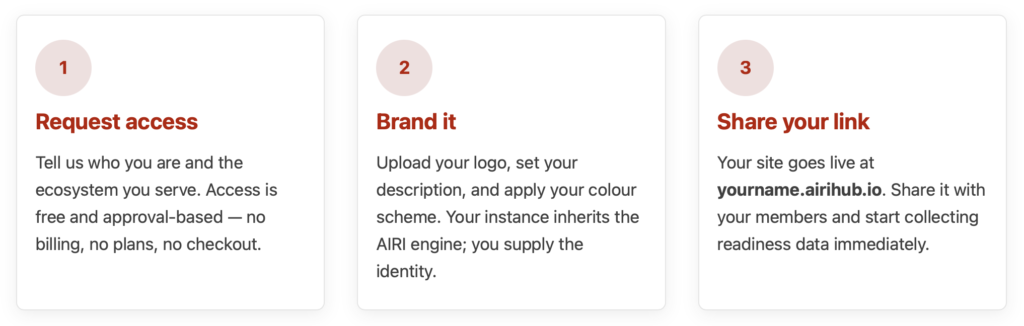
Three principles shaped it, and each one matters more than it looks.
Free and hosted, not licensed. There is no plan, no checkout, no infrastructure for the operator to maintain. Access is approval-based rather than paid. A standard spreads on the number of people who can run it, and every fee is a subtraction from that number.
The operator owns the data. Assessment results belong to the organisation that runs the site. Only aggregate, anonymised statistics are used for reporting. Individual scores stay with the individual — the site administrator never sees them, and neither do I. Trust is the currency of an assessment, and an assessment that quietly harvests personal results is not one people answer honestly.
Assessment-only, on purpose. airihub.io measures readiness. It does not teach. There are no courses on it. That is a deliberate boundary: the full path from assess to learn to transform lives at aiready.sg, and the framework reference lives at airi.foundation. airihub.io does one thing — it lets a whole ecosystem measure where it stands, under its own name — and it does only that.
Why this completes the picture
I have built the same idea at four levels now.
- the AI-First Nation book to carry the argument.
- A framework, airi.foundation, to set the standard.
- A platform, aiready.sg, to take an individual the whole way from assessment to capability.
- And now airihub.io, so that anyone who leads a network of organisations can run the standard for their own ecosystem without long tedious procurement process or getting government grants.
That last part is the point. The measure of an open standard is not how many people admire it. It is how many people run it. In the past, running a national or industry AI-readiness assessment meant commissioning a survey or waiting for a vendor. airihub.io is my attempt to make it a three-step task instead — request access, brand it, share the link — so that there is no barrier, no excuse for not knowing your AI Readiness.
If you lead an association, an agency, a sector body, or a large organisation, and you have ever needed to answer the question “how AI-ready are the people we serve,” this was built for you. It is open, it is free to host, and it is live today.
Deploy your own AIRI site at airihub.io. The framework it runs on is described in full, and free to download, at airi.foundation.