Walk the Talk: How I Built AIReady.sg
Prefer to watch or listen? Here is the narrated version of this essay, in my own voice.
One person, after hours, no grants — and what it says about what AI can now do
I live by one principle: I cannot ask companies and professionals to use AI every day if I do not do it myself.
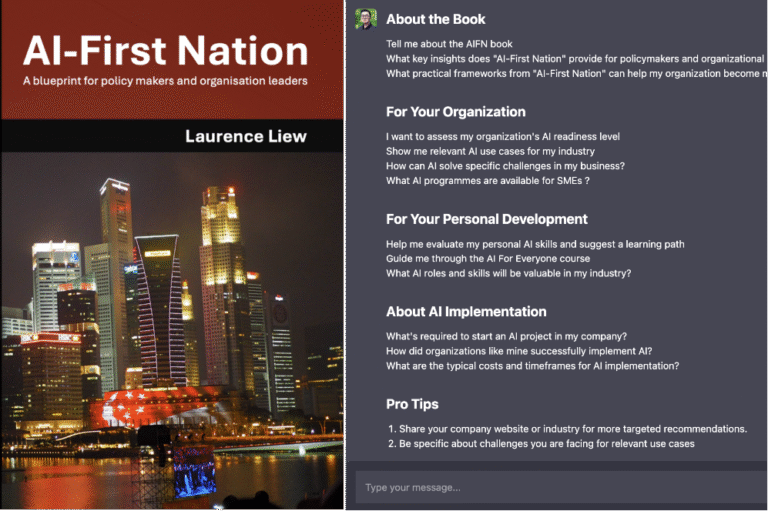
That principle produced my book, AI-First Nation — written with AI, in three months, to prove what the tools could do for one person’s productivity. AIReady.sg is a different order of thing. A book is a productivity task. A platform that assesses your AI readiness, teaches across 25 industries and 6 roles, runs a community, handles enterprise groups, and writes you a plain-English analysis of where you stand — that is not productivity. That is a transformation.
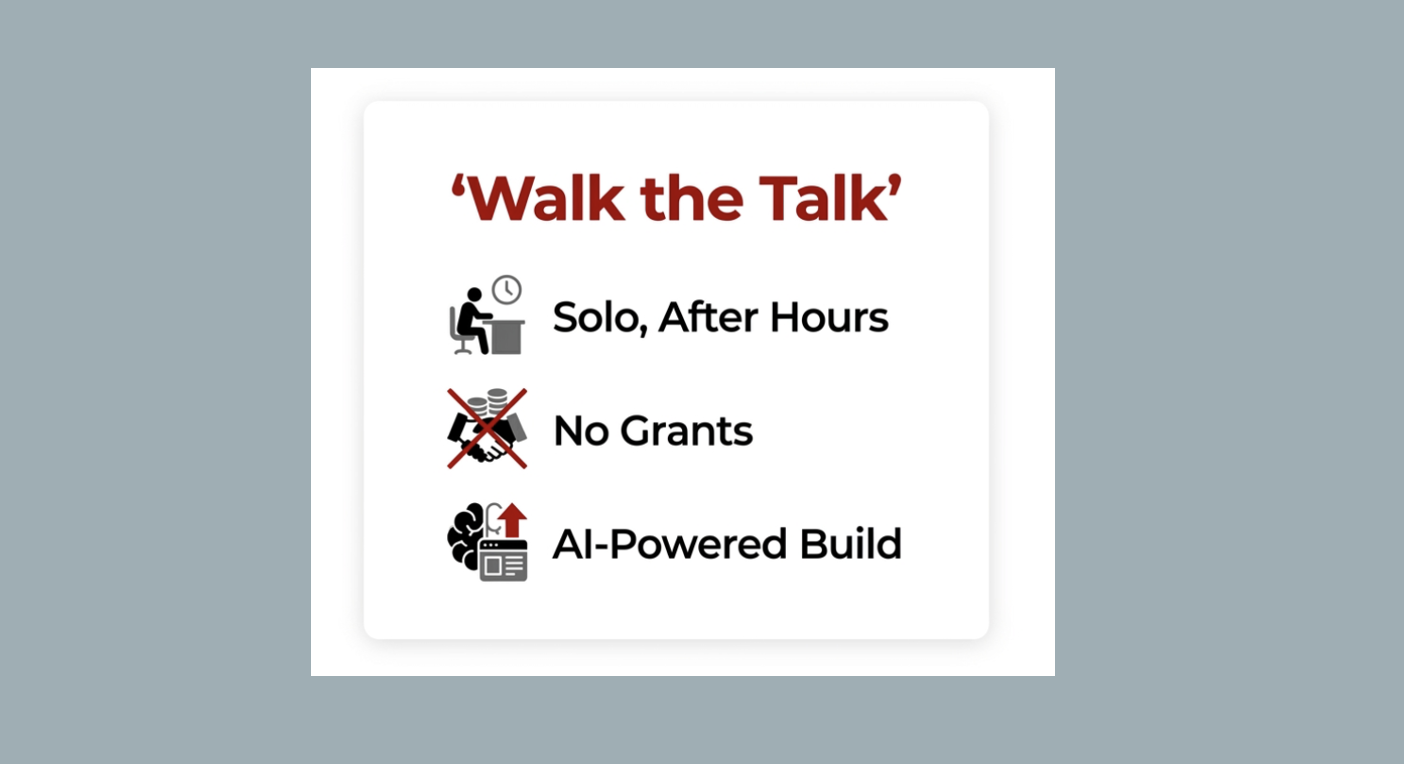
If AI-First Nation proved AI could make one person more productive, AIReady.sg is me proving AI can now let one determined person deliver a transformation that used to require a team, a studio, a content group, and a budget to match. I built it alone, in the evenings and on weekends, after the day job. No grant, no outside funding, no institutional support — my own initiative, not AI Singapore’s, paid for out of my own pocket. Here is how, and what I think it means.
You still need to know things
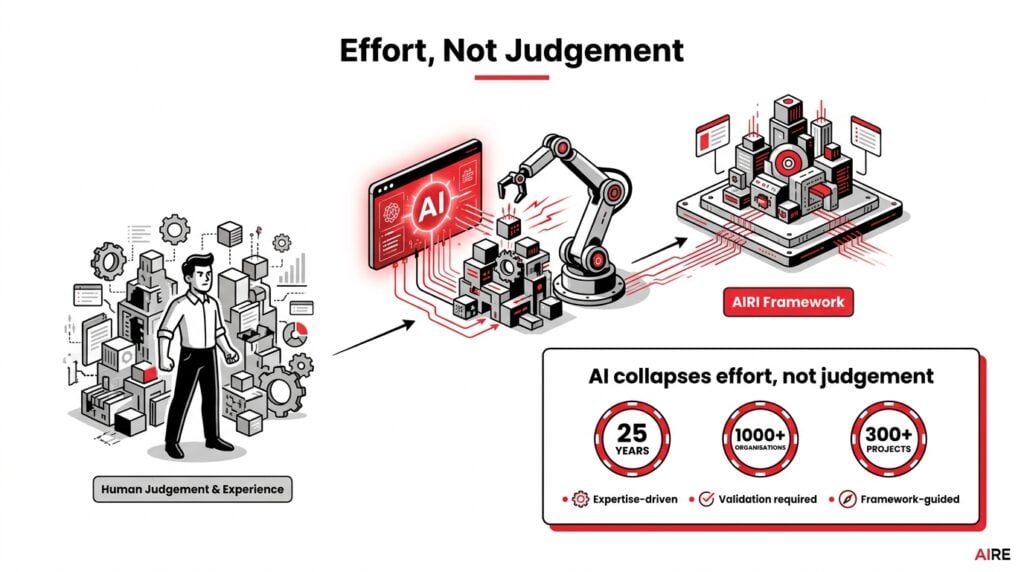
There is a comfortable myth that AI means anyone can build anything now. It doesn’t. AI collapses the effort; it does not replace the judgement.
I could build AIReady.sg because of what I knew before I started: 25 years in and around AI, over 1,000 organisations helped, 300-plus AI projects, and a framework — AIRI — built out of that experience rather than theory. When you ask an AI to build a scoring engine, you still have to know what a correct one looks like — otherwise you cannot tell when it hands you something that reads beautifully and is quietly wrong.
So yes, one person can build this now. But “one person who spent years learning the domain first” is doing most of the work in that sentence, and I would rather be honest than sell a fantasy.
The architecture: boring on purpose
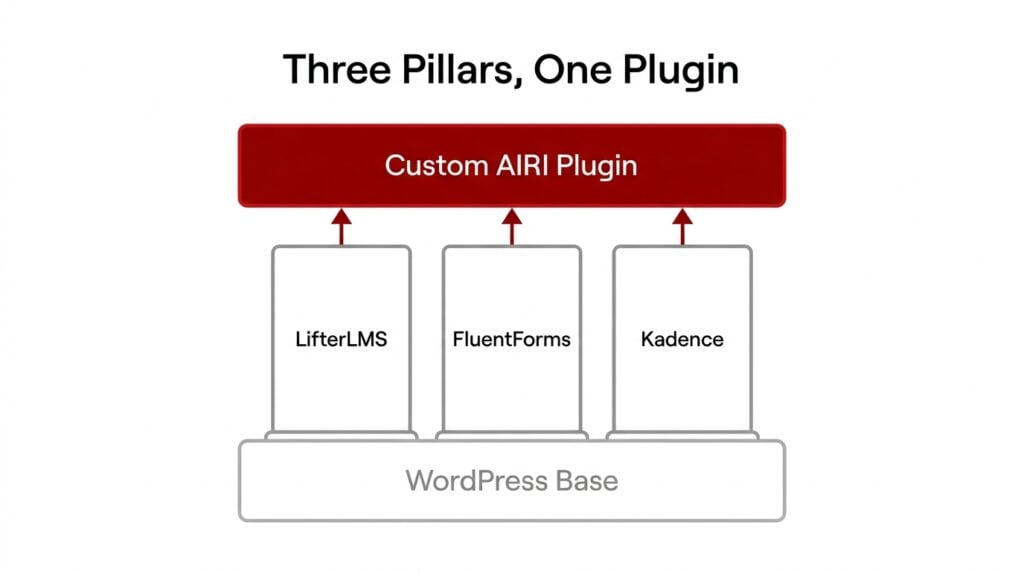
One of the biggest misconceptions about building something ambitious is that the cleverness lives in the architecture. Mine is deliberately boring, and that is the point. I build by one rule: complexity must earn its place. Every plugin, every vendor has to justify the maintenance burden it adds — because I am the one maintaining all of it, alone, at 11 on a Sunday night.
AIReady.sg runs on WordPress, on three chosen pillars and little else. LifterLMS runs the courses, enrolments and quizzes — the single source of truth for learner data. FluentForms delivers the assessments. Kadence keeps every page consistent without a separate page builder. Around those three sits one custom plugin — the AIRI plugin — which takes the raw assessment answers, computes the pillar and maturity scores, and renders your results as a radar chart natively. Collect, compute, display.
When I needed two-factor auth, spam protection and login hardening, I did not install a heavy all-in-one suite that does forty things; I used focused tools and owned the rest as small snippets I control. Fewer moving parts, fewer things that break while I sleep.
How it was actually built
I did not point an AI at the problem and say “build me a learning platform.” That would not have worked. I started with the framework, not the code.
Before a single lesson existed, I used Claude Code to do the research the platform stands on: a structured AI-readiness brief for each of 25 industries, and a clear definition of 6 functional roles. 25 industries across 6 roles gives 150 distinct contexts a professional might sit in. That 150-cell grid is the scaffold; everything else is derived from it.
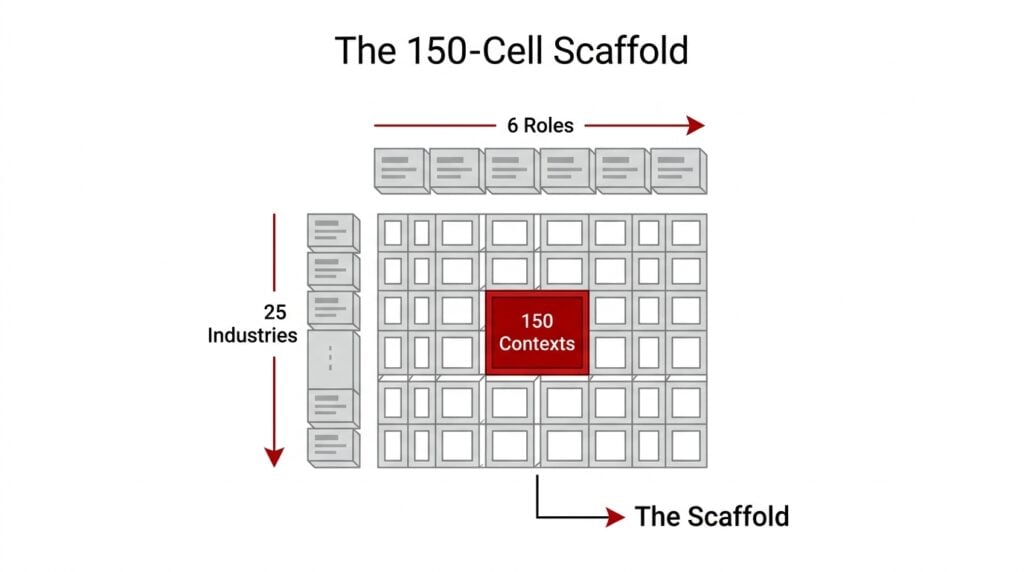
From the scaffold, the content follows. The course is 34 lessons, and most of each lesson is fixed — the core explanation is the same whether you work in a hospital or a bank. But the part that makes it land is not. So inside each lesson sits a short personalised passage, rewritten for every cell of the grid. 34 lessons across 150 contexts is 5,100 personalised snippets, each slotted into an otherwise-static lesson.
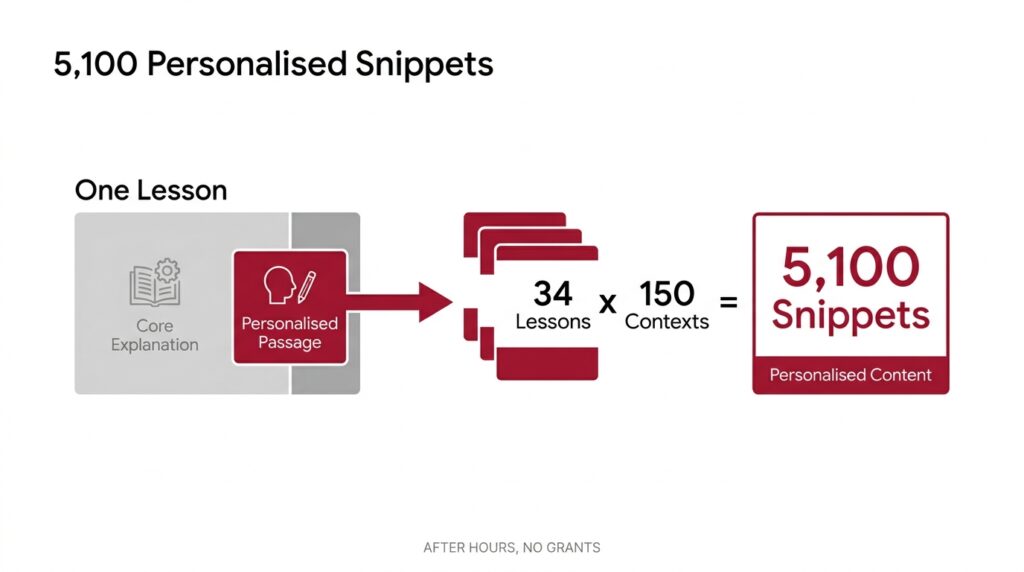
Here is the decision that made it affordable. I generated all 5,100 offline, in Claude Code sessions, on my ordinary subscription — not through the pay-per-call API. The heavy thinking happens once, at build time, and never again. When a learner opens a lesson, no model is running behind the scenes deciding what to say: the right snippet is already written, sitting in the database, and the page simply serves it. The cheapest AI call is the one you have already made and never have to make again.
I stopped one layer short, on purpose. I could have tailored every lesson to each learner’s company — I built and costed the machinery — but that layer cannot be pre-generated: a bespoke overlay per company is a live cost on every use, the exact tax the rest of the design avoids. So I left it switched off. It is available for companies who needs that further customisation.
The rest of the production line runs on the same principle. The narration is generated in a clone of my own voice; the slides with Google’s Gemini image model; and a pipeline stitches voice and slides into finished videos. Before any of it reached a real learner, I ran the whole thing end to end against a synthetic cohort of around 80 accounts, so the failures happened to test users.
Getting the running costs down
Building something once is one problem. Running a 24×7 site that fires thousands of live AI calls is another — a recurring bill a solo project cannot afford.
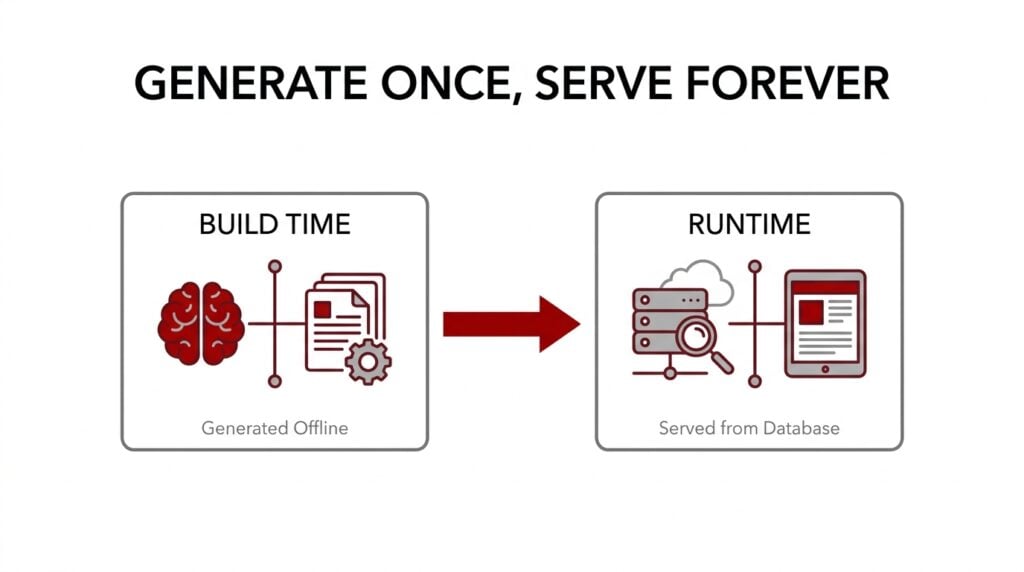
Most of AIReady.sg makes no live AI calls at all, by design. But some must happen in real time, because they depend on you — your AIRI scores, your role, your industry, none of which I can guess upfront — to write your AI-readiness report. Because that fires on every use, its cost is a tax on every user, forever. Left unmanaged, that tax makes free access impossible — and free access is the whole point.
Two decisions kept it under control. First, I stopped paying a search API to do work I had already done. The old report paid a live web search — Firecrawl — to read about a company on every run. So I took web search off the default path: the live report now makes one ordinary request — a plain fetch of the company’s own website — and grounds everything else on the 25 industry briefs I generated offline. Just as useful, but a whole recurring cost gone. Second, I matched the model to the task, not the hype: the calls that remain run on z.ai’s GLM models rather than the most expensive frontier model — a fraction of the price, each task routed to the right size.
Put those together — pre-generate offline, drop paid search, right-size the model — and the recurring cost falls by well over 90%. Not from one clever trick, but from refusing, at every step, to pay a machine to redo work I had already done. To think hard on a sustainable architecture. That is what makes it real: one person can fund the whole thing. No grant. No investor.
Free-first, and why
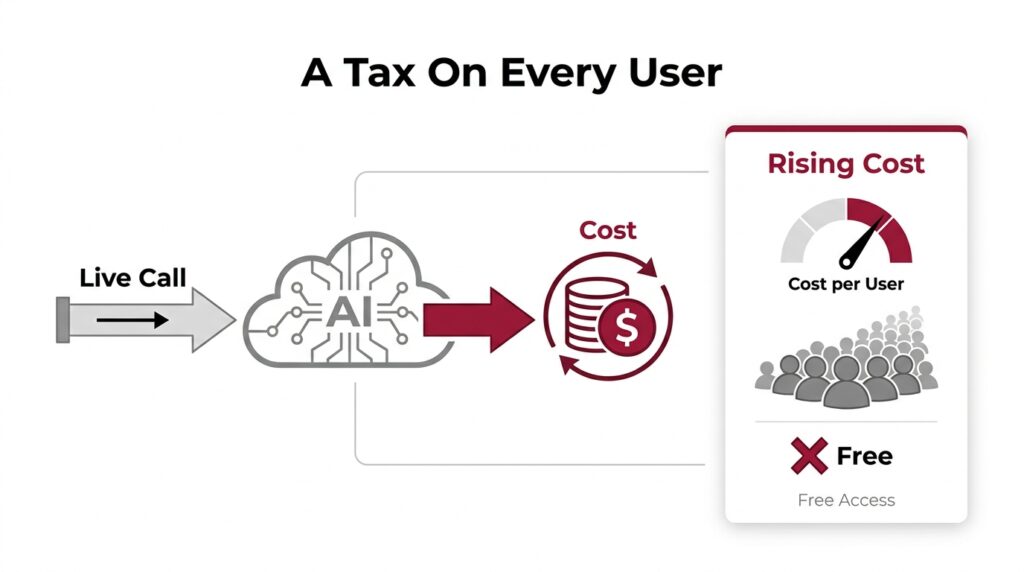
I made AIReady.sg free for individuals and for teams of up to 25. That is not a loss-leader trick; it follows from what the platform is for. The target for most professionals is AI Ready — Level 2: using AI effectively in your everyday work. Most people should reach it and stay there; AI Competent and AI Catalyst are for the specialists and leaders who go further. If the goal is to get a whole population to AI Ready, price cannot be the thing in the way. So it is free — for every individual — and the cost engineering above is what makes that survivable for one person and for a country.
Why this matters
I did not write this to show off a website. I wrote it because the shift underneath it is the whole thesis of my book, now sitting in front of me as a working system.
The barrier to building something genuinely useful has dropped further than most people realise — but it has moved, not vanished. The scarce resource is no longer engineering hours or content production; AI supplies those cheaply, if you direct them well. The scarce resource is knowing what to build, why it matters, and how to tell good output from bad. That still comes from doing the work, for years, before the tools can help you.
If you have that foundation, this is the most empowering moment there has ever been to build. One determined person, evenings and weekends, no grant and no team, can now ship what used to demand all three. I know, because I did it. That is what “AI-First” always meant. Not AI or you. AI amplifies you.
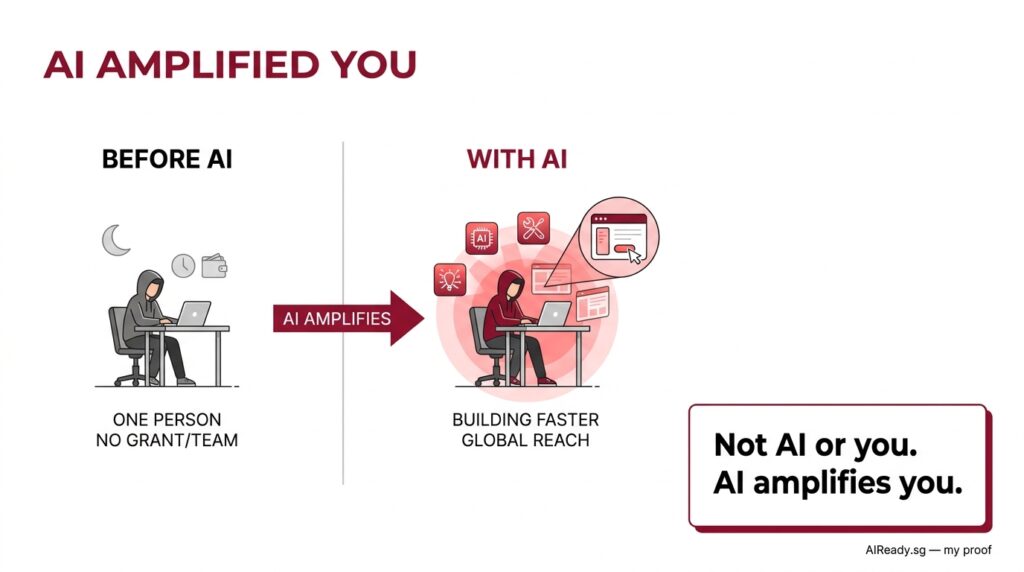
And that is the point of walking the talk: I cannot tell organisations AI can transform how they work unless I let it transform how I work first. AIReady.sg is my proof.
AIReady.sg is a personal initiative of Laurence Liew. It is not affiliated with, endorsed by, or representative of AI Singapore. The AIRI framework is released as a free, open standard under CC BY 4.0.