
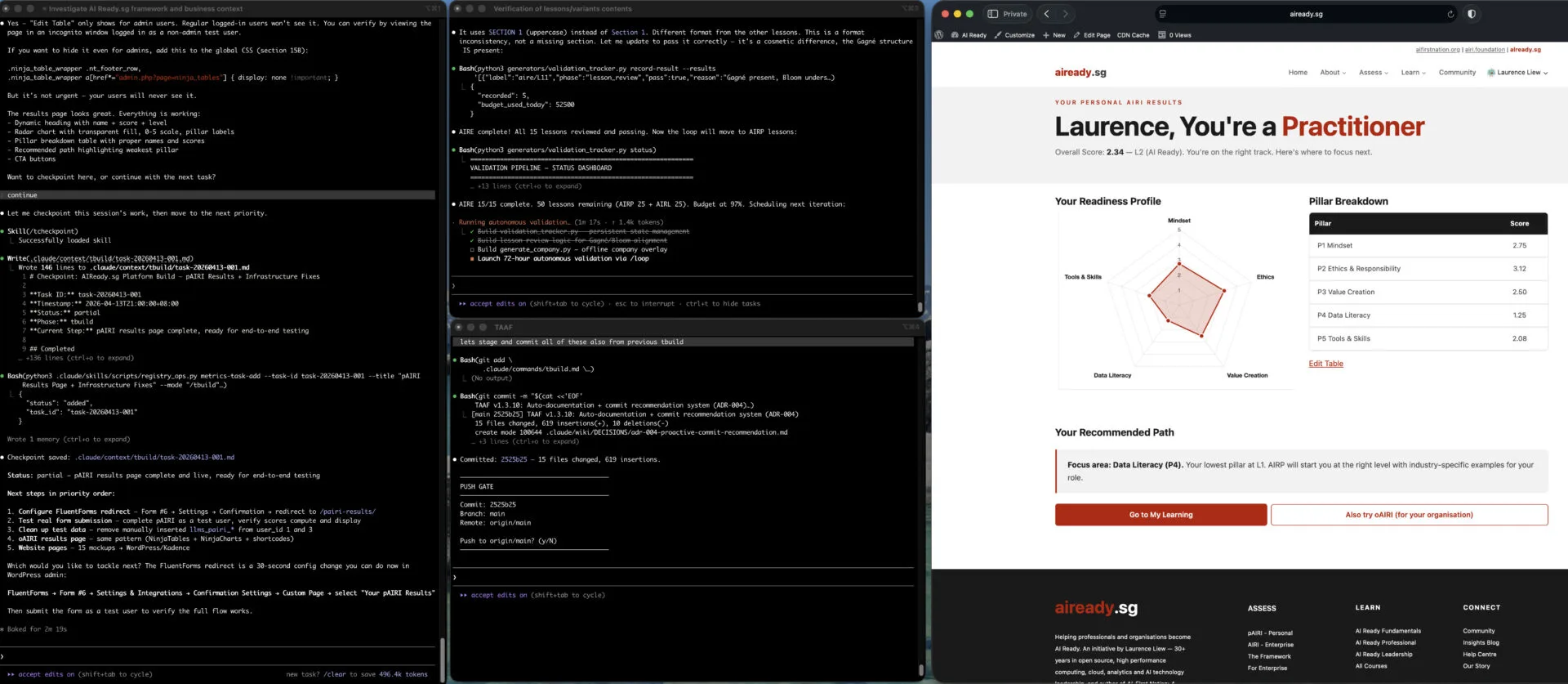
Three AI agents working in parallel. One is running a 72-hour autonomous validation loop across 9,750 lesson variants. Another is building out the aiready.sg website. A third is helping me improve TAAF, our agent framework, while I use it in production.
I am not writing code line by line. I am directing, judging, correcting, and deciding.
This is the future of work.
A domain expert, armed with AI agents, can now take on broader and more complex tasks than ever before. But notice what has become more valuable, not less: the ability to multi-task, to think, to judge, to critique. And here is the part many people miss — technical skills are still required. You cannot judge what you do not understand. You cannot tell an agent what you want if you do not know what good looks like.
So what does this mean for two groups of people?
For PMETs — you already have the hardest part.
You spent years building domain expertise. You learnt the technical fundamentals in school and early in your career. As you moved into management, you picked up judgment, context, and the ability to make trade-offs under uncertainty. That combination is exactly what makes someone valuable in the agentic AI era.
What you are missing is the AI layer on top. This is PLUS-skilling, not re-skilling. Add AI capabilities to your existing expertise, and you become the person who can direct a team of agents to deliver outcomes your younger self could not have imagined. Do not walk away from your domain. Double down on it, and add AI.
For fresh graduates — this is the harder conversation.
The traditional path was: learn technical skills in school, apply them in your first few jobs, accumulate judgment over a decade, then lead. AI has compressed that timeline dramatically. Entry-level work that used to build judgment through repetition is now being done by agents. Research from Google last year showed that junior developers using AI tools perform 7 to 10 percent worse than those without, precisely because they have not yet developed the judgment to know when the AI is wrong.
So what must you do, and what must schools change?
For fresh grads
Do not skip the fundamentals. Build deep technical skills in something real. Work on projects where you have to debug, fail, and recover. Seek out messy, ambiguous problems — not polished assignments. Learn to critique AI output, not just accept it. Ask why, not just how.
For schools
The timeline to build experience and judgment must be compressed into the curriculum itself. That means more project-based learning with real stakeholders. More deliberate practice in making judgment calls under uncertainty. More exposure to AI tools paired with the discipline to evaluate their output. Less rote assessment, more messy-problem assessment.
What we are doing different in AI Singapore?
At AI Singapore, we built AIAP and LADP precisely to solve this —months of immersive, always with real-world ai problem statements where apprentices and learners learn to make engineering judgments, not just execute prompts. Eighty percent of our apprentices and learners do not have a computing background. The common thread is not what they studied. It is the willingness to learn and deepen their fundamentals and build judgment by doing real work.
The future of work is not humans versus AI. It is domain experts, with judgment, directing AI agents to do what neither could do alone.
The question for all of us is simple: what are you adding this year?
This is really beneficial for building and directing AI agents