
The Rise of AI Agents: A Glimpse into 2025 and Beyond
The year is coming to a close, and what a year it has been for AI. As 2025 approaches, the true revolution is just beginning. AI agents are poised to reshape not just technology, but how we live, work, and learn.
Scaling AIAP
AI Singapore’s AI Apprenticeship Program (AIAP) and AIAP Foundation are strategic initiatives building a skilled AI workforce.
Since we started AIAP and 100E in 2018, we have completed 200 AI projects and trained over 400 Singaporeans to become real-world AI engineers.
The number one question I have been asking myself and my team is how can we scale this 10x-50x, to train 1000 to 5000 Singaporeans a year for AI job roles but using the limited resources we have.
However, scaling AIAP has been difficult over the years:
- Access to real-world projects
- AIAP uses real-world AI projects from the 100E programme to train the apprentices, and this is a fundamental difference between AIAP and the rest of the training programs available in the industry today.
- But the costs, resources, and time involved in getting Singapore companies and agencies to participate in the 100E programme mean only dedicated organizations committed to AI transformation came forward.
- When AIAP cohorts had more apprentices than projects, we created internal projects (2020 onwards) by our AI engineering and AI/ML/Data Ops teams to provide real-world projects for our apprentices to learn. We took a lack of industry projects as an opportunity to build AI products led by our AI engineers and assisted by our AIAP apprentices. This led to the development of projects like TagUI, PeekingDuck and SEACore NLP (the predecessor to AI Singapore’s South Seat Asia Large Language Model SEA-LION)
- Shortage of qualified candidates for AIAP
- We receive 300-400 Singaporean applications for each AIAP intake.
- However, less than 10% pass our technical assessment and interview. This is despite the many online and in-classroom learning resources we have in Singapore and which many of these candidates participated in.
- These classes offered some foundational knowledge, but fell short in providing the essential real-world, end-to-end development experience and best practices our AIAP candidates require to pass the technical assessment.
AIAP Foundation: Laying the Groundwork
AIAP Foundation launched during SWITCH in November 2024 addresses the two issues above.
The Juruku Architecture: Powering AIAP Foundation
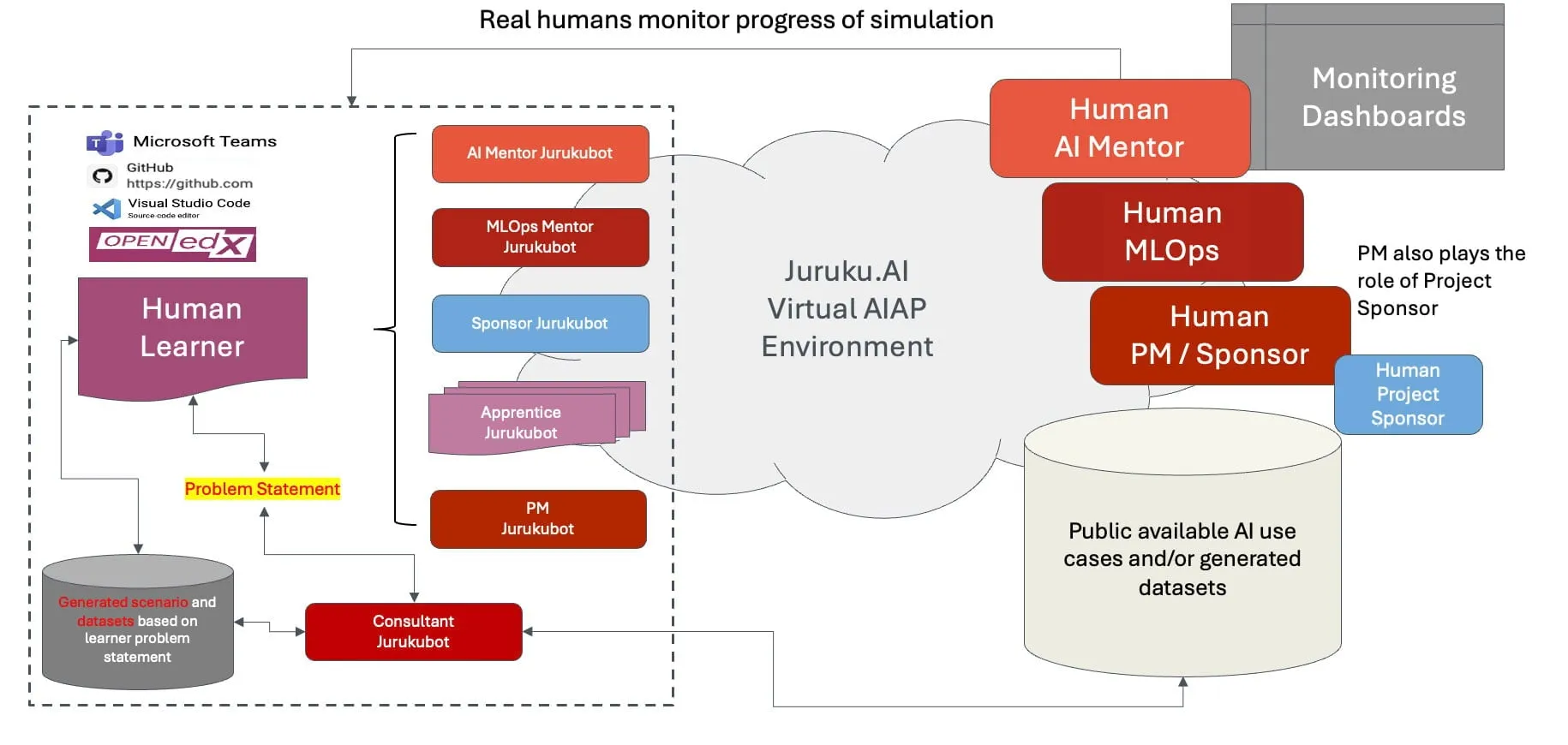
At the core of the AIAP Foundation is the Juruku architecture, a combination of human mentorship and AI-powered agents that guides learners through deep-skilling and project phases.
Juruku is a cloud-based platform powered by large language models (LLMs) and agent technologies, built on our experience from over 17 cohorts of the AIAP program over the past six years, where we have successfully completed more than 200 AI projects and trained more than 400 Singaporeans to become proficient AI Engineers.
Mentoring the “AIAP-Way”
AIAP has 1 mentor to 4-6 apprentices. To scale up the number of apprentices, we either hire more mentors or use AI-agents as mentors. There was no way AI Singapore could get the funding to hire 10x the engineers to train 10x the apprentices; that is neither prudent nor sustainable. So we trained AI-agents as mentors.
Today, we have AI agents that serve as mentors to guide apprentices when they are learning AI/ML concepts and programming. The AI mentor agents will provide personalized guidance, feedback, and support while the learner is undergoing the AIAP Foundation programme. This way, we can scale the number of Singaporeans trained in the AIAP-way while maintaining a reasonable cost structure.
“Real-World” Projects
In AIAP we use real-world projects from the 100E programme to train the apprentices. We replicated this today with our AI Consultant agents that collaborate with learners to scope business problems into AI projects and generate the required datasets. This avoided the need to get real-world projects from the industry, but more importantly, the learner will work on a project close to his/her heart and is relevant to his/her work.
The outcome is an immersive, personalized learning experience that bridges the gap between theory and real-world application.
AI agents beyond education
AI agents are digital allies capable of learning, adapting, and acting autonomously, not merely lines of code. The AIAP Foundation described above shows what they can do in learning. By 2025, we will have Project Manager AI agents and even AI agent apprentices to make the entire AIAP Foundation learning experience more realistic.
However, their potential extends far beyond education. I envision AI agents as service workers, healthcare assistants, or even creative collaborators.
The following are my predictions for 2025:
- Customer service AI agents will handle first-level support queries, but what is exciting is how domain experts (the customer service managers themselves) can now customize these agents using no-code platforms. They are teaching these AI agents the company’s SOPs, product knowledge, and even cultural nuances specific to different market segments.
- We will see nurses and medical administrators building AI agents to handle patient scheduling, medication reminders, and preliminary symptom assessment. These are healthcare professionals who understand the domain challenges and are now empowered to create solutions, not computer science graduates.
- In financial services, compliance officers will develop AI agents to monitor transactions and flag potential issues. Instead of writing complex code, they are using agent frameworks to encode their years of experience into automated systems that can work 24/7 in plain English.
- Even in manufacturing, production supervisors will create AI agents to monitor equipment performance, predict maintenance needs, and optimize production schedules. They are combining their shop floor experience with user-friendly AI tools to build agents that speak their language.
- Business analysts’ tasks will evolve; instead of just creating PowerPoint decks and Excel models, they will build AI agents that can generate reports, analyze trends, and suggest strategic recommendations. These AI agents will become their digital apprentices, learning from each interaction and continuously improving their capabilities.
This democratization of AI agent development is what we need for true digital transformation. It is about empowering the people who understand the business challenges to create their own solutions, without waiting for IT departments or external vendors.
We have demonstrated and validated that the aforementioned can be achieved. Our LLM Application Developer Programme (LADP) has assisted over 30 companies and government agencies in developing their own AI agents and chatbots. In this process, our AI mentors provide coaching, advice, and mentorship to their staff, many of whom are domain experts rather than engineers to address specific business problems.
The rise of AI agents heralds a new era of productivity and efficiency. By automating tasks, providing insights, and generating creative content, they will reshape how we work. This is about empowering humans, not replacing them, allowing us to focus on what we do best: innovate, strategize, and connect.
Conclusion
The AI revolution is not simply technological. As AI agents become more sophisticated, they will reshape our world in ways we can only begin to envision.
AI Singapore is proud to be at the forefront of this revolution, developing the talent and tools that will position Singapore as an AI-First nation.
Embrace the future. Explore the world of artificial intelligence and its possibilities.