When One Human Leads Eight AI Agents in Parallel
A Snapshot from the frontline of the Future of Work
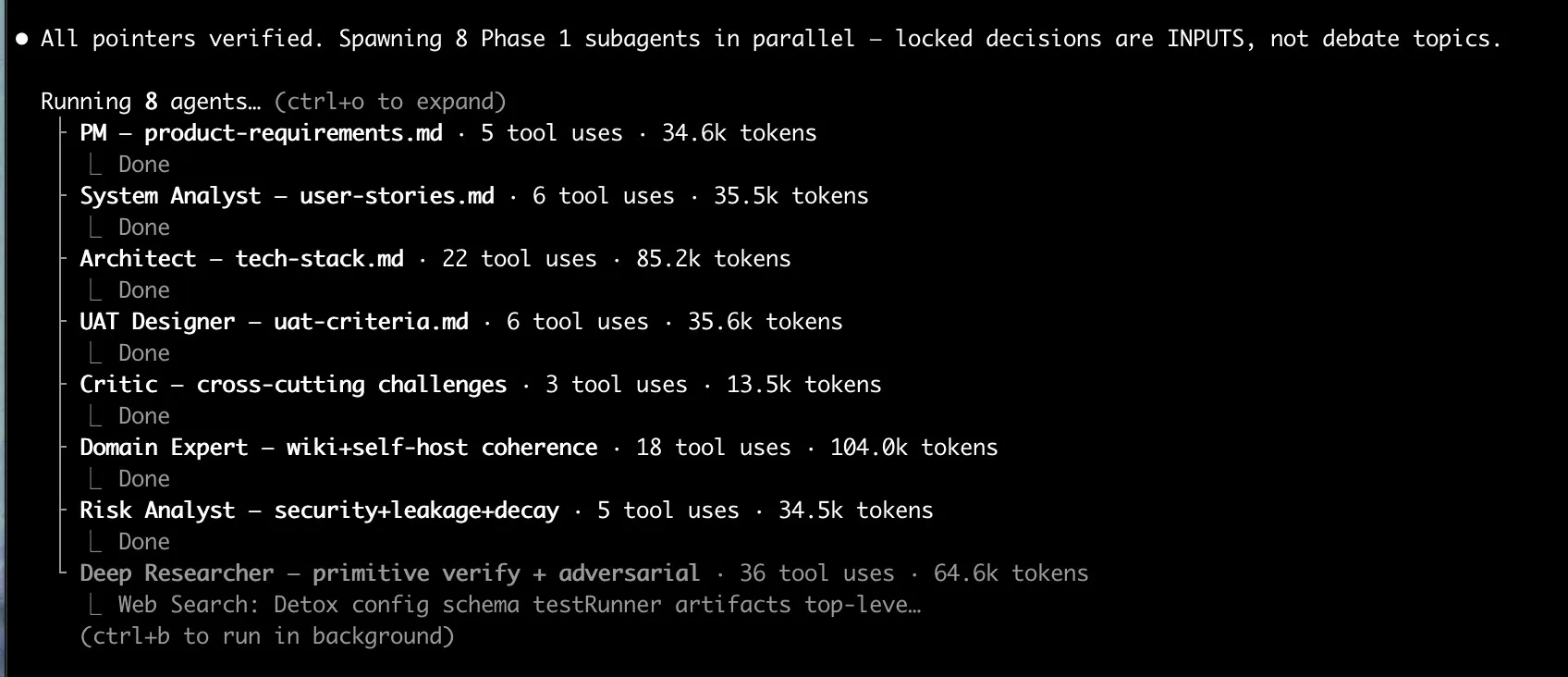
Earlier this week, I captured a screenshot from a working session in TAAF, the agent framework I have been experimenting with. In a single run, the framework spawned eight specialised subagents in parallel — each with a distinct role, each running independently, each reporting back to one orchestrator: me.
The roster reads like a software product team:
- A Product Manager drafting product requirements
- A System Analyst writing user stories
- An Architect specifying the technology stack
- A UAT Designer defining acceptance criteria
- A Critic examining cross-cutting challenges
- A Domain Expert checking coherence across the stack
- A Risk Analyst surfacing security, leakage, and decay concerns
- A Deep Researcher verifying primitives against adversarial cases
Between them, these eight agents executed 101 tool calls and consumed approximately 407,500 tokens — in parallel — to produce a coordinated body of work that, before this generation of AI tooling, would have required a multi-disciplinary human team and several days of meetings.
I did not write the requirements. I did not write the code. I did not write the test plan.
So what did I do? I made the decisions. I framed the problem. I locked the boundaries — the screenshot itself notes, “locked decisions are INPUTS, not debate topics.” I evaluated outputs. I caught what each agent missed. I decided what to keep, what to discard, and what to send back for another pass.
This is Stage 3 of AI Empowerment: Leading Avengers
For the past two years I have been describing the Three Stages of AI Empowerment.
- Stage 1 is Just One Person — the world before AI tooling, where the only leverage was your own hands and the people you could hire.
- Stage 2 is the Iron Man Suit — PLUS-skilling, where AI augments a single domain expert to ten times their previous productivity. This is where most of the workforce conversation has been concentrated.
- Stage 3 is Leading the Avengers — orchestrating a team of specialised AI agents, each more focused and more tireless than any single junior colleague, and bringing the human judgment that ties the work together.
That screenshot is Stage 3 in motion. It is no longer a thought experiment.
What This Demands of the Workforce
The implications for the workforce are significant. The question is no longer “will AI replace me?” The question is “can I orchestrate AI?”
Three things become non-negotiable, and they are exactly what we have been building at AI Singapore:
- Strong domain foundations. You cannot evaluate an Architect agent if you do not understand architecture. You cannot push back on a Risk Analyst agent if you cannot tell a real risk from a hallucinated one. AI does not eliminate the need for expertise. It raises the price of not having it.
- PLUS-skilled AI fluency. You keep your domain expertise, and you add the AI orchestration layer on top. We have said this consistently: PLUS-skill, do not re-skill. The 500-plus AI engineers we have produced through AIAP, with 90 percent placement and 300-plus real-world projects deployed, are living proof that this combination — domain plus AI — is what the market actually rewards.
- The judgment to know when an agent is wrong. Speed without judgment is just faster mistakes. The Six-Step AI Workflow research published by Google in early 2025 (What do professional software developers need to know to succeed in an age of Artificial Intelligence? Matthew Kam and team) found that junior developers with under one year of experience perform 7 to 10 percent worse with AI assistance, precisely because they lack the judgment to evaluate, calibrate, and finalise the AI output. AI amplifies whatever judgment you bring. If you bring none, it amplifies that too.
The Future of Work is Already Here
This is not a hypothetical drawn from a 2030 forecast. The screenshot is from this week. Eight agents. One orchestrator. Real work shipped.
At AI Singapore, this is exactly what we are training our AI Apprentices, our AIRI participants, and our LearnAI learners to do — not to compete with AI, but to lead teams of AI agents toward outcomes that matter.
The Iron Man Suit was the warm-up. Leading the Avengers is the main event. The professionals who learn to do this in 2026 will be the ones who define what their teams, their organisations, and their industries look like in 2030.
The screenshot above is what one person leading eight agents looks like today. The question for every reader is straightforward: how soon will you be doing the same?