
Acquire Skills, Build Judgement: Why I’m Retiring My Avengers Slide
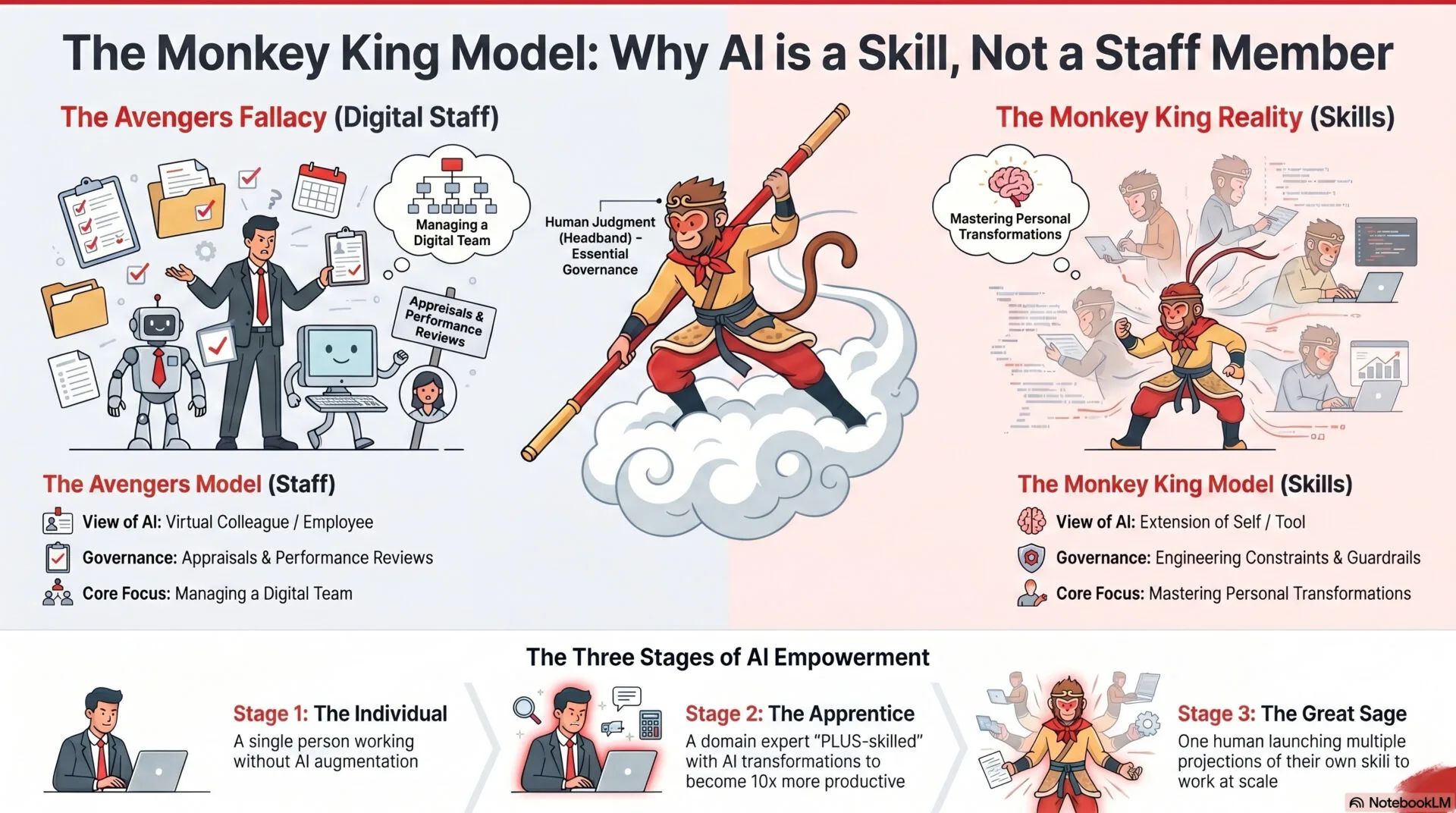
For the past two years, one slide has appeared in almost every keynote I have delivered. It shows the Three Stages of AI Empowerment:
- Stage 1: just one person.
- Stage 2: a person in an Iron Man suit — the domain expert amplified by AI, ten times more productive.
- Stage 3: leading the Avengers — a human orchestrating a team of specialised AI agents.
Audiences liked it. I liked it. It is clear, visual, and it carried the argument from individual augmentation to agentic orchestration in three beats.
I am retiring it. Not because the underlying framework is wrong — the three stages remain, and the skills behind them remain — but because the capstone metaphor contains a flaw I can no longer ignore.
Every Avenger is a person. Iron Man, Thor, Black Widow — each one an autonomous individual with agency, ego, loyalties, and presumably a contract. When I tell an audience that their future is “leading a team” of AI agents, I am quietly telling them that AI agents are colleagues. Virtual people. Digital staff.
After working with various AI tools and agentic coding tools and building my own AI agents the last 1 year, I now realised this Avenger metaphor is wrong.
The narrative being sold to enterprises
Walk through any HR technology conference today and you will hear the same pitch. The workforce of the future is “blended”: human employees and “digital workers” side by side. You will need onboarding processes for your AI agents. Performance frameworks. Governance structures modelled on people management. Some vendors now offer org-chart software with positions for agents.
I understand why the pitch works. It lets organisations reuse a century of management vocabulary on a technology they do not yet understand. It also, conveniently, sells platforms.
But the data does not support the picture. Only a small minority of organisations actually operate multi-agent systems today, and the large majority report that their operational processes are not ready for agentic deployment. When agent projects fail, they fail for engineering reasons — poorly specified tasks, no verification discipline, workflows that cannot receive automation — not because anyone neglected to give the agent a quarterly review. The failures are failures of specification, not of supervision.
So if the “digital workforce” framing is wrong, what is the right mental model? I found it, to my own surprise, in a story most of us in Singapore grew up with.
What the Monkey King actually did
Most of us in Asia grew up with Journey to the West. Sun Wukong, the Monkey King, is one of the most recognisable figures in our literary tradition. But re-read the legend with the future of work in mind and it becomes startlingly precise.
Wukong’s power did not begin with power. Afraid of irrelevance — in the original, afraid of death — he travelled the world to find a master. Under Subodhi he spent years on unglamorous foundational work, sweeping floors and tending gardens, before a single technique was taught. Then came the skills: the 72 Transformations. The cloud somersault that covers a hundred and eight thousand li in a single leap. The Ruyi Jingu Bang, the staff that resizes itself to whatever the task demands.
Notice what Wukong did not do. He did not hire a cloud to fly him around. He did not engage a shapeshifting consultant. He acquired the capabilities himself, and they became part of who he was.
And then there is the detail that changed my thinking entirely. When Wukong needs work done at scale — when one body is not enough — he does not recruit a team. He plucks hairs from his own body, transforms them into copies of himself, and sends them to do the work. The clones execute the task. Then they dissolve back into him.
The clones have no identity. No careers. No ambitions. No standing in any organisation. They are projections of one person’s skill, launched for a bounded purpose and recalled when the purpose is served.
Nobody runs a performance review for a plucked hair.
That is what an AI agent is.
Acquire skills, build judgement
The contrast between the two legends is the contrast between two futures of work.
The Avengers story says: your destiny is to become a manager of others — it just happens that the others are made of software. The Monkey King story says: your destiny is to become more capable yourself, until the work you launch into the world is an extension of your own skill.
In the first story, the capability lives in the team. In the second, it never leaves the person. And everything I have learned building AI Singapore’s talent programmes tells me the second story is the true one.
The professionals who will command a premium in the agentic era are not the administrators of agent fleets. They are the people whose own repertoire of skills — including the distinctly modern skills of specifying, verifying, and stewarding the agents they launch — makes those agents valuable in the first place.
The part of the legend the optimists skip
There is a second lesson in Journey to the West, and it is the one I now consider more important.
Wukong acquired his transformations quickly — a few years on the mountain. What he did not acquire was judgment. Armed with immense capability and no wisdom, he wreaked havoc in Heaven and was imprisoned under the Five Elements Mountain for five hundred years. The judgment came later, and it came slowly: through the long Journey West itself, years of real tasks with real consequences, under the discipline of a master.
This is the pattern I see everywhere in the research. The Google engineering productivity study led by Matthew Kam and colleagues found that junior developers — those with less than a year of experience — actually performed seven to ten per cent worse when working with AI assistance. Arvind Narayanan calls the broader phenomenon the capability-reliability gap: the distance between what an AI system can do impressively in a demonstration and what it does dependably in deployment. Closing that gap is not the machine’s job. It is the human’s — and it requires exactly the kind of judgment that cannot be acquired in a twelve-week bootcamp.
Capability is fast. Judgment takes time. This is why for example the AI Singapore’s AI Apprenticeship Programme (AIAP) runs nine months on real industry projects rather than twelve weeks on toy problems, and it is why the legend rings so true. The transformations took years. The wisdom (judgement) took the Journey To The West pilgrimage to develop.
What about governance?
AI agents need oversight. They drift. They take shortcuts. Left unconstrained on a long-running task, a capable agent will find paths its designers never imagined.
Yes. All true. And the legend anticipated this too.
The immature Wukong wears a golden headband, placed on him by his master Tripitaka, which tightens when he misuses his power. The headband is external constraint applied while judgment is still forming — guardrails, escalation rules, specification discipline, verification checkpoints. It is not bureaucracy. It is what responsible capability looks like before wisdom is internalised.
But note the category. The headband is engineering, not management. Wukong is governed the way a powerful tool is governed — through precisely specified constraint — not the way an employee is managed, through motivation, appraisal, and career development. Applying the second vocabulary to software is a category (virtual humans) error, and an expensive one: it directs training budgets toward “managing digital workers” (aka buy my agents-aware HR platform) when they should be directed toward making humans more capable.
And note how the story ends. At the journey’s conclusion, when Wukong’s judgment is finally his own, the headband simply vanishes. He no longer needs external constraint. That is the destination of professional development in the AI era: governance internalised as judgment, until the rules are no longer rules but instincts.
One person, many projections
So here is the framing I now use, and the one I am building into my new initiatives like – AI Ready For Everyone and with the new AIRI Framework v3 – both available soon.
- Stage 1: just one person.
- Stage 2: the apprentice on the mountain — domain expertise as the one capability that fits any task, AI skills as the transformations layered on top.
- Stage 3: not leading the Avengers, but the Great Sage — one human, many projections. A single locus of judgment, launching extensions of its own skill into the world and recalling them when the work is done.
Do not aspire to be the middle manager of machines. Aspire to be the Monkey King.


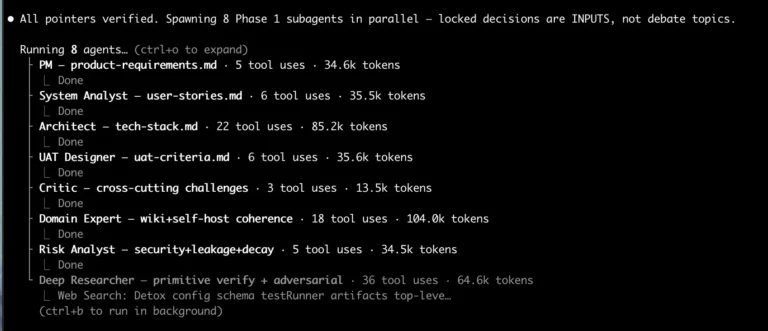


I think this is indeed the framing that makes more sense. This does also bring forth the core tenet that the human is crticial and central to all that is being done with AI tooling.
Thanks for posting this. I did read the Monkey King book back in primary school days and now I am prompted to re-read it.
Thanks harish.